A Visitor’s Looking List for a Local Craft Market
A visitor’s looking list for a local craft market helps you notice materials, recurring forms and display choices without turning browsing into an inspection.
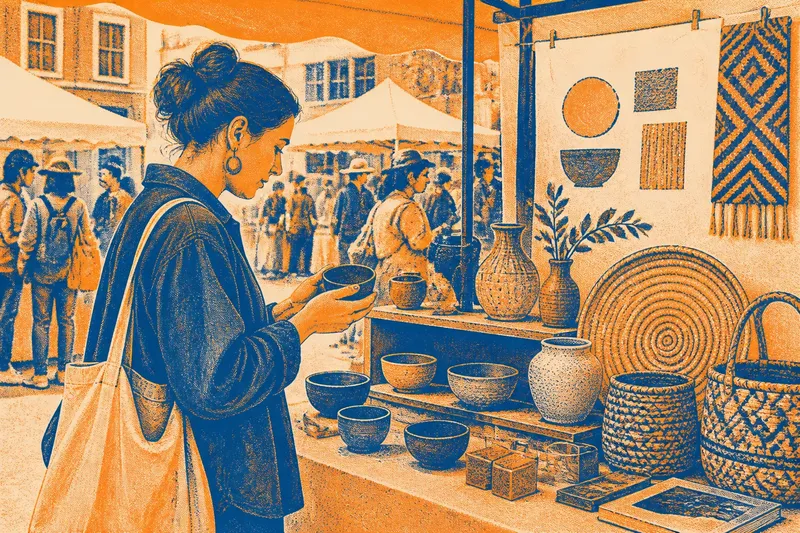
A visitor’s looking list for a local craft market can make a crowded row of stalls easier to read: notice what objects are made from, what forms recur and how each maker presents their work. You do not need to judge quality, verify a story or ask every seller questions. Choose a light approach that leaves room for wandering, conversation and simply enjoying what catches your eye.
Markets reward different kinds of attention. You might arrive with a particular material in mind, follow a pattern that keeps appearing, or take in the way a stall invites people to browse. These approaches can overlap, but keeping one in the foreground helps you look without treating makers as exhibits.
Which way of looking suits your visit?
Think of these approaches as different lenses, not a route you must complete. A material-led visit suits anyone curious about how clay, wood, fibre or metal is used. A form-led visit is useful if you keep noticing similar shapes across unrelated stalls. A display-led visit works well when you are interested in how a maker makes choices visible to passers-by.
- Follow materials if you want to notice texture, finish and the range of objects made from one substance.
- Follow recurring forms if bowls, woven patterns, carved edges or repeated motifs keep drawing your attention.
- Follow display choices if you want to understand how objects are grouped, handled or explained for shoppers.
If you are visiting with a friend or family member, each person can choose a different lens. You can then compare what you noticed without turning the walk into a scorecard. One person may remember a row of glazed cups; another may have noticed that the maker showed them beside the clay used for their surface.
What can materials tell you at a glance?
Begin with what is visible: a smooth or rough surface, a woven edge, a visible join, a polished area or a change in colour. Notice whether the material seems to be doing the same job across several objects, or whether one maker uses it in an unexpected way. Keep observations descriptive: “the rim is left unglazed” is more useful and less presumptuous than guessing why.
Look for how an object combines materials. A basket might pair a woven body with a different material at the handle; a small wooden container might have a contrasting lid. You can notice the relationship without assuming which part took longer to make or what a material means to the maker.
Light, distance and crowding can change how a surface appears. If it is welcome and the object is clearly available for handling, ask before picking it up. A material may feel different from how it looks, much like a book cover can appear soft from across a room but feel firm under your fingers.
How do repeated forms become interesting?
Choose one visible feature, such as a rounded rim, a stepped edge or a repeated stripe, and see whether it appears elsewhere. It may recur within one stall, across several stalls or in quite different materials. The point is not to decide that the objects have the same origin; it is to notice likeness and difference side by side.
Ask what changes as a form repeats. A shallow dish and a deep bowl may share a curve but invite different uses. A motif may look bold on a large textile and delicate on a smaller one. These comparisons help you attend to shape and scale without making claims about cultural meaning that the maker has not offered.
Say you notice a series of small vessels with similar rims at one stall. You might compare how each rim meets the body, then listen if the maker chooses to explain the variation. The observable result is a more specific impression of that stall’s work, not a conclusion about the maker’s process or intentions.
What can a stall’s display help you notice?
Look at how the objects are arranged. Are similar pieces grouped together, or are different forms placed side by side? Is a finished object paired with a material sample, a tool, a drawing or a written description? These choices can suggest what the maker wants a visitor to see first, though a busy market may also limit the space available.
Notice where labels sit and what they explain. A label might name a material, a technique, a place or a practical use; another stall may rely on conversation. Neither arrangement tells the whole story. Treat the display as an invitation to look, not a promise that every question has a short answer.
If an object is displayed within reach, do not assume it is meant to be handled. A simple “May I pick this up?” gives the maker room to say yes, explain how to hold it or decline. If the seller is serving another visitor, waiting or browsing from where you are is a considerate choice.
How can you ask about a maker’s work naturally?
Start from something you can genuinely point to: “Could you tell me about the material in this piece?” or “I noticed this pattern across several of your objects; is there something you’d like visitors to know about it?” Such questions leave the maker in control of how much to share.
Listen for the distinction between an explanation the maker offers and an interpretation you supply. If they describe a technique or a use, you can ask a follow-up about that subject. You do not need to press for a personal story, a cultural explanation or details they have not chosen to discuss.
A quiet response, a short answer or a seller’s attention turning to another customer is a natural stopping point. You can thank them and continue looking. Browsing remains a shared public activity, not an interview that the maker owes you.
Which questions help you look without judging?
What should I write down after a stall?
Jot down a visible detail you may otherwise forget: a particular finish, a way objects were grouped or a question the display prompted. Keep notes neutral and brief, and ask before photographing people or anything whose display is not clearly open to photography.
Should I compare objects from different makers?
Yes, if you compare what you can see, such as shape, material or arrangement, rather than ranking makers or treating resemblance as proof of a shared story. Differences can be just as interesting as repeated features.
What if I do not know the material or technique?
Describe the appearance instead of guessing: “a pale, woven surface” is a sound starting point. If the maker is available and seems open to conversation, ask what they call the material or process.
How do I leave a conversation politely?
Thank the maker for explaining, then step aside so other visitors can browse. You can continue looking without buying, provided you respect the stall’s space and any handling requests.
How do you choose a looking approach on the day?
Let your available attention decide. If the market is busy or you have little time, choose one lens and follow it for a few stalls rather than trying to record every detail. When there is more space to linger, move between materials, forms and displays as your curiosity shifts.
Where a label or maker’s explanation gives a specific name for a material, technique or use, follow that wording rather than replacing it with a guess. If the information is not offered, it is fine to leave the question open. This keeps your notes grounded in what you can observe and what the maker has chosen to share.
A useful visitor’s looking list for a local craft market is not a demand to cover every stall. Take away one detail you can describe clearly, one explanation you heard with permission and one question you are happy to leave unanswered. That is enough to make the visit attentive while keeping the makers’ work—and your own enjoyment—at the centre.