Why a Handle Changes the Way an Object Meets the Hand
Why a handle changes the way an object meets the hand: a one-week routine for noticing grip, reach and repeated use in familiar household objects.
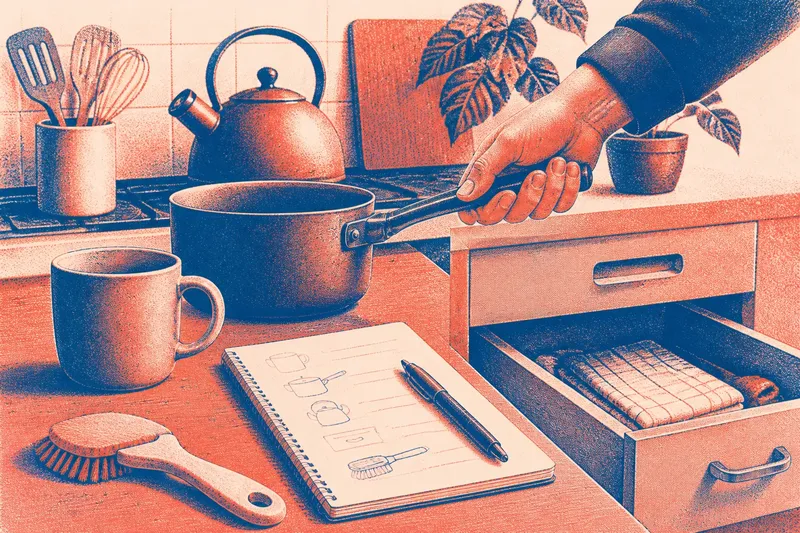
A saucepan handle that makes you twist your wrist is telling you something about the whole pan. Why a handle changes the way an object meets the hand becomes clear through ordinary use: grip, reach and repetition shape how confidently an object can be picked up, moved and put down. Spend a week noticing those encounters, and small design choices become easier to see.
This is not a plan to redesign your kitchen or judge every object by comfort alone. It is a way to observe how handles guide the hand, where they interrupt movement and what kind of use they seem to expect. A handle is a little like a doorbell: a small part that sets the terms of a much larger interaction.
What should you notice before the week begins?
Choose a few familiar objects with different jobs: a mug, a saucepan, a drawer pull, a kettle or a cleaning brush. Include objects you use often and one you reach for only occasionally. You do not need to buy anything or take an object apart.
Keep a small notebook or a note on your phone. For each object, record where your hand first lands, how many fingers or which part of the palm takes the load, and whether you adjust your grip. Note the setting too: a mug may be lifted at a table, while a pan is carried across a busy kitchen.
- Choose objects you can observe during normal tasks.
- Notice whether the handle is integral to the body or attached as a separate part.
- Record the direction of approach: from above, from the side or from underneath.
- Write down any awkward movement without assuming the handle alone is to blame.
- Keep observations brief, so the routine fits around ordinary use.
Follow the schedule by observation, not by deliberately making an object awkward or carrying it in an unsafe way. If a task involves heat, blades or a heavy load, use the object as intended and leave experiments aside.
On the first day, where does your hand reach?
Watch the moment before contact. Do you reach straight towards the handle, or does the object make you move around its body? A cabinet pull that is easy to see and approach from the front asks for a different movement from a loop tucked close to a lid.
Notice height and clearance as well as shape. A handle may fit the fingers comfortably but sit so close to a wall, neighbouring object or lid that the hand cannot approach it naturally. Record the path your hand takes and where it has room to move.
Say you usually open a cupboard with a recessed pull. Imagine that, during the week, you notice your fingertips repeatedly brushing the door face before they catch the recess. The useful observation is not that the pull is inherently poor; it is that its position and the way you approach the cupboard affect the contact.
On the second day, what kind of grip does the handle invite?
Handles can invite a pinch with fingertips, a curled grip around a bar, or support from the palm. A small knob often encourages fingertips; a broad loop can admit several fingers; a long, rounded grip may let the hand close more fully. These forms distribute contact differently, but no single grip suits every task.
Pay attention to whether your hand closes around the handle or presses against it. A mug handle may leave room for one finger or several, while a brush handle may rely on the palm and curled fingers. Compare the intended movement: a brief lift, a steady hold or a repeated push and pull.
Do not confuse a familiar grip with a universally comfortable one. Hand size, mobility, gloves and the direction of force can all change how the same shape feels. Describe what you observe in plain terms rather than grading it as good or bad.
On the third day, how does the object behave in motion?
Notice what happens after the object leaves its resting place. Does the handle keep your hand clear of the body, help orient the object, or make you rebalance it? A kettle handle has to relate to the body’s centre and pouring direction; a drawer pull mainly has to communicate where to pull.
For a saucepan, consider the difference between lifting it from a hob and carrying it to a counter. The handle’s reach from the hot body, its angle and the place where the hand supports it all shape the movement. A second helper handle can change how the load is shared, but only if the user can reach it and coordinate both hands.
Record any change in grip during movement. If you begin with fingers around the handle and shift to a palm-supported hold, that adjustment may reflect the object’s weight, balance or destination as much as the handle’s contour.
On the fourth day, what changes with repeated use?
Repeat the same ordinary task at different points in the day. A handle that feels unobtrusive during a single lift may become tiring when used again and again. Repetition also reveals whether you can find the grip without looking, and whether the object’s form offers a consistent place for the hand.
Observe your habits rather than trying to count every movement. Do you always grasp the same section of a pan handle? Do you hook a finger through a mug handle before lifting, or take hold of the body instead? These habits show how the object’s design meets the user’s own routine.
When a handle is used often, small interruptions matter: a sharp transition, a slippery surface or a grip that forces a cramped wrist can keep drawing attention. Make a note of the interruption and the task in which it occurs. That context is more useful than a general verdict.
On the fifth day, what does the handle ask of the other hand?
Some objects are handled with one hand while the other steadies, opens or clears a path. A jar lid, for instance, depends on two hands working against one another; a cleaning brush may be guided by one hand while the other holds the surface or object being cleaned.
Look for competing demands. If one hand must hold a lid open while the other grasps a small pull, the handle’s size and location affect the whole sequence. A pan with a long handle may be easy to move with one hand but occupy space that complicates reaching for a utensil.
Write down the sequence of actions in a short phrase: steady, grasp, lift; or hold, turn, release. This captures an important part of handle design: the handle does not work in isolation, but as a point in a chain of movements.
On the sixth day, what do household handles reveal about their setting?
Compare objects used in different places around the home. A bathroom cabinet pull may be approached with damp hands; a garden tool handle may meet gloves; a mug is used close to the face and often carried only briefly. The same smooth surface or narrow grip can behave differently across these situations.
Notice material and finish without trying to infer more than you can see. Wood, metal, rubber and glazed ceramic each have a distinct surface and temperature to the touch. Ask whether the material supports the task and whether wear, residue or cleaning demands affect your grip.
Consider where the object is stored. A handle designed to hang from a hook has a different relationship to reach and visibility from one designed to sit in a drawer. Storage can determine whether the user grasps the handle first or has to lift the object by its body.
What questions help explain a handle’s effect?
Why do some handles feel easier to find?
A handle’s visibility, contrast and position can make it easier to recognise before you touch it. A projecting pull offers a clear target, while a flush recess may blend into a surface and rely on touch or a visible cut-out.
Does a larger handle always feel better?
No. More room can help some grips, but a bulky form may obstruct nearby movement or feel awkward for a brief task. The relevant question is whether the shape gives the hand the space and support that the object’s use calls for.
Why do two handles on the same object differ?
They may serve different moments or directions of force. A main handle can support carrying while a smaller secondary grip helps lift, steady or open part of the object.
What should you do if a handle makes a task uncomfortable?
First note the particular action and the point of discomfort, then check whether posture, object balance or the surrounding space contributes. If changing or adapting a handle would involve a safety-sensitive product, follow its maker’s instructions and seek suitable professional advice where needed.
On the final day, what can you conclude from your notes?
Read the week’s observations together and look for recurring relationships: a handle that is hard to reach when an object is stored, a grip that changes during carrying, or a form that works well for a quick action but less well when repeated. Keep each conclusion attached to the object and task you observed.
Choose one object and write a short description that another person could understand: where the hand approaches, what grip the form invites, what movement follows and what adjustment you noticed. This is more precise than saying that the handle is comfortable or uncomfortable, because it explains how the design participates in use.
Why a handle changes the way an object meets the hand is ultimately a question about relationships: between fingers and form, reach and storage, movement and the object’s purpose. Keep the notes for a later comparison when you encounter a different version of the same object. A familiar task can then reveal not only what a handle looks like, but what it quietly asks the hand to do.