The Handmade Myth: Why Irregularity Does Not Prove an Object's Story
Learn how to describe an irregular object without guessing its origin, maker or method, using visible details and careful, useful language.
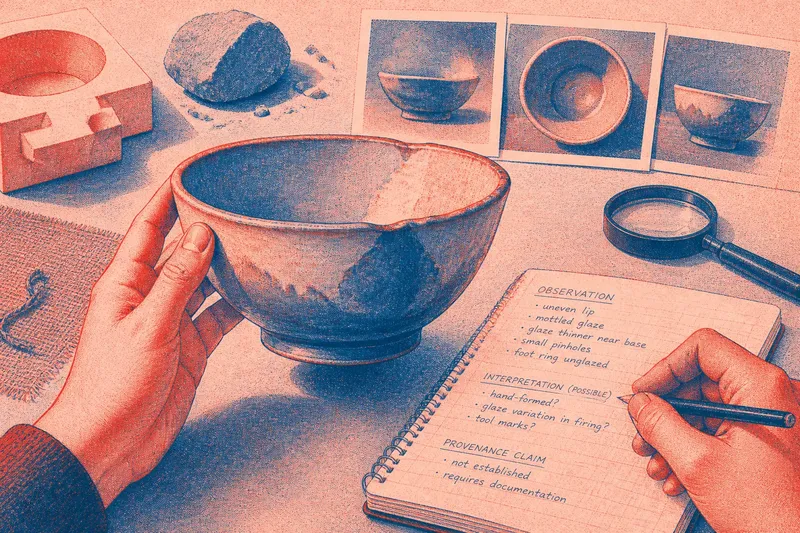
An uneven rim does not prove that a pot was made by hand. If you are describing an irregular object, begin with what you can see, then separate that observation from any claim about how, where or by whom it was made. This small pause makes a description more accurate without making it dull.
What can you actually see?
Start by naming the object and its visible features in plain terms. Note the shape, surface, colour, pattern and any marks that stand out: a rim that rises and falls, a repeated ridge, a brush-like streak or a seam along one side.
Use words that point to observable details. “The blue glaze is thinner near the base” describes a visible difference. “The maker left the base unfinished” adds an explanation that the surface alone may not support.
Look from more than one angle and, where practical, in steady light. A shadow can make a smooth surface appear dented; a reflected highlight can make a change in glaze look like a scratch. Do not handle an object if its setting or condition makes that inappropriate.
How do you separate observation from interpretation?
Write down the observation first, then treat each explanation as a possibility rather than a fact. Irregularity is a feature, not a production record. Similar-looking variations can come from different materials, tools, processes, later wear or deliberate design choices.
A useful description can distinguish three layers:
- Observation: “The surface has shallow parallel grooves.”
- Interpretation: “The grooves may be tool marks.”
- Provenance claim: “A local craft worker carved them by hand.”
The first statement is directly checkable. The second is a cautious reading. The third needs reliable evidence beyond the appearance of the grooves. Keep those layers separate, especially in labels, catalogues and sales descriptions.
Why does variation have several possible causes?
Materials do not always behave uniformly. Clay can shrink as it dries; wood grain can shift the way a cut appears; woven fibres can vary in thickness; printing ink can settle unevenly. Those effects may occur in handmade production, but variation can also be introduced by machinery, finishing, storage or use.
Tools and processes can leave patterns that resemble one another. A repeated mark might come from a hand tool guided along a surface, a mould, a roller or a later repair. Conversely, a skilled maker may produce a highly consistent result, while a manufactured object may show small differences between pieces.
Think of a crumpled paper edge: its unevenness tells you that the edge is not smooth, but not who crumpled it or why. Objects carry more information than paper, yet one visible feature rarely tells their whole production story.
What wording keeps a description accurate?
Choose verbs that match the strength of your evidence. “Shows”, “has” and “appears” are useful for visible properties. “Suggests” can signal an interpretation, but it does not turn a guess into a fact. For uncertain production details, state the uncertainty plainly or leave the claim out.
Say you are writing a gallery label for a bowl with a slightly uneven lip and mottled glaze. You could write, “The bowl has an uneven lip and patches of darker glaze.” If a catalogue record separately identifies its maker and process, you could attribute that information to the record; the visible features alone do not establish either detail.
For a brief description, ask yourself:
- Does each adjective name something a reader could locate on the object?
- Have I called a surface variation a defect, a tool mark or a sign of handwork without evidence?
- Am I presenting a likely explanation as a confirmed fact?
- Can I replace a broad label such as “rustic” with a more precise description?
- Have I kept information about the maker or origin distinct from my visual reading?
When reliable documentation supports a claim, identify it as documented information rather than presenting it as something the object’s appearance proves. If you do not have that support, a direct visual description is still useful.
Which questions help you describe irregular objects?
Does an uneven surface mean an object is handmade?
No. It may be consistent with handwork, but machinery, material variation, finishing and wear can also create unevenness. Describe the surface first and make a production claim only when separate evidence supports it.
Can a handmade object look regular?
Yes. A maker can use templates, moulds, jigs or careful repeated movements to produce consistent forms. Regularity alone does not identify a manufacturing method.
What should I write if I do not know the maker?
Describe the object’s form, material appearance, colour and visible marks without assigning an identity. If a source provides attribution, name that source or make clear that the attribution is recorded rather than visually established.
How do I describe a possible tool mark?
Say what the mark looks like and where it appears, such as “a narrow groove runs along the edge”. If its cause is uncertain, use “possibly” or omit the proposed cause; do not call it a tool mark as settled fact.
How should you revise the finished description?
Read the text once for visible detail and again for hidden claims. Circle words that imply a maker, place, tradition, age or method; then check whether you have evidence for each one. Replace unsupported claims with concrete observations, or remove them.
Use a maker’s statement, collection record or other relevant documentation when the description needs to address provenance or process. A label, manufacturer’s instructions or local rules may govern what can be claimed in a particular setting; follow the applicable requirements.
A careful account does not flatten an object into a list of surface traits. It lets a reader notice texture, shape and finish while making clear where observation ends and interpretation begins. That distinction is the most reliable way to describe irregularity without turning it into an invented story.